New working papers
and new publications
We have just published four new preprints as POLAR working papers. You may now explore new work on the relationship between rising inequality and inequality of educational opportunity in our Working Paper #6 Does rising economic inequality strengthen the intergenerational transmission of educational advantage? Evidence from 32 Western countries (download here), look into the relationships between rising inequality and citizens’ belief in meritocracy in our Working Papers #7 Climbing the ladder or falling behind: How social mobility shapes perceptions of meritocracy in the wake of rising inequality (download here) and #8 The Paradox of Inequality that isn’t: Rising Economic Inequality Depresses and Polarises Citizens’ Belief in Meritocracy (download here), or you may read about the effects of inequality on citizens’ perceptions of social conflict in our Working Paper #9 Increasingly polarized? Inequality, prosperity, and perceived socioeconomic conflict in advanced economies (download here). As before, please do not hesitate to get in touch with the authors in case you may have any comments, suggestions or feedback on this new work.
In fact, our Working Paper #9 has just been published as an advance-access-article with the European Sociological Review. Co-authored by Cristian Márquez Romo, Simon Bienstman, and Markus Gangl, the article is available as an open access publication here. In addition, Cristian Márquez Romo successfully published a second article that is exploring the relationship between rising inequality and public demand for redistribution in the International Political Science Review. This article is also already available in open access from the publisher website here.
New working papers
Have you already seen the latest working papers from the POLAR project?
Our Working Paper #4 explores The economic foundations of democratic legitimacy: Exploring the relationship of macroeconomic inequality and trust in democratic institutions in Europe, and Working Paper #5 examines Economic inequality and the cross-cutting of social circles: Evidence for a Great Gatsby curve in European marriage and partnership markets!
The full working papers are available for download from here (WP#4) and here (WP#5). We look forward to hearing about any comments you might have on this work!
New publication
Don’t be surprised to see POLAR contributing to methodological research when required. In the new article “A generalized ordered logit model to accommodate multiple rating scales”, Markus Gangl introduces a flexible ordered logit model to allow for pooled data analysis across different response formats in rating scales within a single model. The article has just been published with Sociological Methods & Research and is accompanied by a Stata ado to fit the new multiscale ordered logit model.
The full article is available in open access from here!
To install the mscologit ado file, type “ssc install mscologit” from within Stata. After installation, type “help mscologit” to obtain more background on syntax and ado capabilities. The ado file is accompanied by the gss_illustration.do file that provides a very simple illustration of the model in an analysis of split-sample data on respondents’ political trust from the public GSS 1984 data.
New publication
The article “Unemployment and Social Integration: Analysing the Impact of Financial Strain, Social Roles, and Identity” by Carlotta Giustozzi has just been published with SpringerNature in KZfSS Kölner Zeitschrift für Soziologie und Sozialpsychologie.
The article is open access!
Join the POLAR Team!
The POLAR project invites applications for a post-doc with a focus on inequality and social cohesion.
The position is available from October 1st until the end of the project funding in September 2025. See the job posting on the university website for more information.
New publications
The article “Explaining the ‘democratic malaise’ in unequal societies: Inequality, external efficacy, and political trust” by Simon Bienstman, Svenja Hense, and Markus Gangl is now available for early view in the European Journal of Political Research. The article is open access and can be obtained from the publisher’s website.
The article “Does inequality erode political trust” by Simon Bienstman is published in Frontiers in Political Science and available in open access on the journal’s website.
Interview in “UniReport”
For the University’s UniReport Carlotta Giustozzi spoke with Dirk Frank about her dissertation on labour market marginalisation and social integration.
The Interview can be found here.
New team members
We welcome Dr. Claudia Traini and Sven Ehmes as new POLAR team members. Dr. Claudia Traini joined our team in October 2022 as a postdoctoral researcher and Sven Ehmes in November 2022 as a doctoral researcher.
Peter A. Berger Dissertation Price
This September Carlotta Giustozzi won the Peter A. Berger Price issued by the DGS-Section ‘Social inequality and social structure’ for the best dissertation of the past two years together with Katharina Kunißen. In her thesis ‘Social Consequences of Labour Market Marginalisation in Germany. Analysing the Impact of Social Identities and Values’, she examined how difficulties at the labour market accumulate over time and how they affect social integration and civic participation. The book is published 2022 with Budrich Academic Press.
New publication
We are happy to announce that Carlotta Giustozzi’s dissertation »Social Consequences of Labour Market Marginalisation in Germany« is now published with Budrich Academic Press.

Two new POLAR Working Papers available!
We are happy to announce that two new working papers from the POLAR project are now available for download from the publications page.
Our POLAR Working Paper #2 is on “Explaining the ‘Democratic Malaise’ in Unequal Societies: Inequality, External Efficacy and Political Trust” is (click here for direct download), and Working Paper #3 has a methodological focus on “A Generalized Ordered Logit Model to Accommodate Multiple Rating Scales” (direct download from here).
As always, we look forward to receiving your questions, comments or suggestions!
POLAR presentation in the Research Colloquium “Analytical Sociology” at LMU Munich (Zoom), June 15
Markus Gangl is going to present results from the POLAR project in a Zoom session of the Research Colloquium “Analytical Sociology” at Ludwig-Maximilians-University in Munich. For a joint session with colleagues from the Institute of Statistics, he will address the question “Does Rising Inequality Reduce Social Cohesion? New Results Using Hybrid Multilevel Regression Models and Four Decades of Repeated Surveys in 32 Countries.”
The colloquium session will be held over Zoom on Wednesday, June 15, 2022, 4:15pm – 5:45pm (Berlin time/Central European time). To join the Zoom session on June 15, please follow this link. If you are interested in additional sessions of the research colloquium in the current summer semester, you may find the full schedule here.
The talk will be based on our POLAR working paper “A New Old Macro-economics of Social Cohesion: Rising Prosperity Still Trumps Rising Inequality, at Least for Many”. The full working paper is available for download here.
Join the POLAR team!
The POLAR project invites applications for two positions of a research fellow (m/f/d; pre- or post-doc). Both positions are available from July 1, 2022 until the end of project funding by March 31, 2025. See the job posting on the university website for more information.
POLAR presentation at the Politics & Society Workshop Series 2022 in Milan
Carlotta presented joint work with the POLAR team exploring how different dimensions of economic inequality affect political trust at the Politics & Society Workshop Series 2022 in Milan, Italy the 17th& 18th March this year.
Thanks to the organizers for this wonderful workshop!
For more info on the event see: https://www.soziopolis.de/fileadmin/Editorial/Calls/CfA_Individual_and_Contextual_Effects_10.1.2022.pdf
First POLAR working paper and DIGCLASS seminar webstream available
We are happy to release our first working paper “A New Old Macroeconomics of Social Cohesion: Rising Prosperity Still Trumps Rising Inequality, at Least for Many”, which now is available for download here. More working papers are to come up soon, so please feel free to check our publications page for updates now and then. And of course, we appreciate your comments and feedback on our research.
In addition, Markus Gangl’s digital presentation “Rising inequality as a political problem: Is there a negative effect of rising inequality on democratic trust, and if so, why?” in the DIGCLASS Seminar Series has been recorded by the European Commission’s webstreaming services. In case you missed the original event, you may now watch the presentation here.
More POLAR research presentations coming up during the winter term 2021
Markus Gangl will give presentations of POLAR research on the relationship between rising income inequality and changes in social trust on two further occasions, namely in the Seminar Series of the University of Oslo’s Research Unit Social Inequalities and Population Dynamics and in the Seminar Series of the Frankfurt Section of the Research Institute for Social Cohesion (FGZ-RISC). The talk “in” Oslo was given on Tuesday, October 26, noon, over zoom, but the talk in Frankfurt had to be rescheduled from November 15 to some new date in the summer semester 2022. In case you are interested in attending the Frankfurt talk, please watch out for a new seminar announcement and then contact the organizers at the FGZ-RISC ahead of time about opportunities to attend.
Both talks are based on the paper “A New Old Macroeconomics of Social Cohesion: Rising Prosperity Still Trumps Rising Inequality, at Least for Many”, which will be shortly available as a POLAR working paper from this website – so watch out for further news.
In January 2022, Markus Gangl will furthermore revisit POLAR research on the relationship between rising income inequality and political polarization. Specifically, he will ask whether the negative effect of inequality on political trust is driven by material self-interest or by citizens’ political preferences. The talk “Rising inequality as a political problem: Is the negative effect of inequality on democratic trust a matter of self-interest or citizens’ political preferences?” will be part of the DIGCLASS Seminar Series on January 25, 2022, 3pm. In case you are interested in attending this zoom talk, please see the seminar announcement on the EC Science Hub website for further details as well as the link to the public Webex session.
Conference season is keeping team POLAR busy
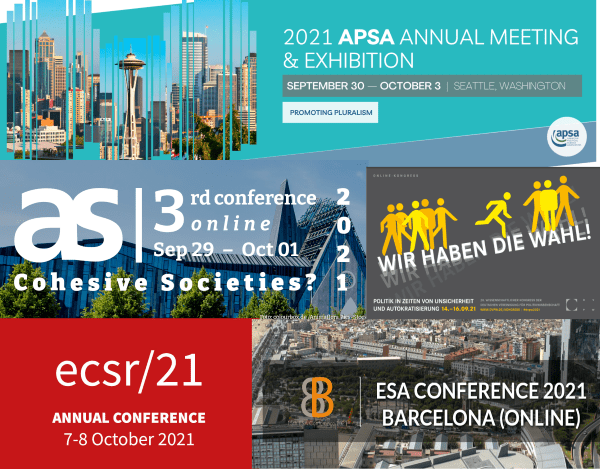
The team will be present at the General Conference of the Academy for Sociology and at the ESCR Annual conference. The programs can be found if you click on the link. Markus Gangl will also provide a keynote at the AS conference.
In addition, Svenja Hense presented a paper on the policy preferences of classes at this year’s DVPW congress and the APSA meeting.
Upcoming POLAR presentations at the 2021 AS online conference “Cohesive Societies?”
This year’s conference of the German Academy of Sociology (AS) will be held online on the theme of “Cohesive Societies?” between September 29 and October 1, 2021. Given its highly topical umbrella theme, we are very happy to have two contributions from the POLAR project at the conference.
On September 29, Markus Gangl will give a keynote lecture based on the working paper “A New Old Macroeconomics of Social Cohesion: Rising Prosperity Still Trumps Rising Inequality, at Least for Many”, and on October 1, Simon Bienstman, Svenja Hense, and Markus Gangl will contribute a paper presentation of their working paper “Explaining the democratic malaise: testing perceived responsiveness as a mechanism for the inequality-trust link“.
More information about the conference can be found here. The conference program features a distinguished set of keynote speakers, including Richard Wilkinson, Delia Baldassarri, Fabian Pfeffer and Michael Zürn, among others. And best of all: thanks to generous funding, registration for the conference is free of charge! So spread the word & see you “in” Leipzig then!
Upcoming Talk at the 15th ESA Conference 2021
On September 3rd, Carlotta Giustozzi will give a presentation with the title “Beyond financial strain: Explaining the relationship of unemployment and civic participation through values and social identity” at the 15th ESA virtual Conference, Barcelona. She will present findings from her dissertation project on the effects of unemployment on civic participation in Germany with SOEP panel data focusing on social identity and individual values as explanatory mechanisms.
Successful PhD defense

On July 13, Carlotta Giustozzi very successfully defended her PhD thesis. The thesis looks at the social consequences of cumulated labor market marginalisation and was supervised by Markus Gangl and Patrick Sachweh. Huge congratulations, Carlotta, from everyone else at Team POLAR!
Presentation at the Sciences Po OSC Scientific Seminar
On June 18, Markus Gangl gave a presentation at the OSC Scientific Seminar at the Sciences Po’s Observatoire Sociologique de Changement in Paris. Under the heading “A New Old Macroeconomics of Social Cohesion: Rising Prosperity Still Trumps Rising Inequality, at Least for Many”, Markus Gangl presented new findings from the POLAR project to examine the relationships between rising inequality, increasing prosperity and social trust in 32 affluent countries.
More information about the program of the seminar series
Talk at the Cluster Colloquium
On May 18, Markus Gangl gave an online presentation at the colloquium of the Cluster of Excellence “The Politics of Inequality”, based at the University of Konstanz. The talk dealt with the question “Is Rising Inequality a Threat to Democracy?” and summarized first findings from the POLAR project.
More information about the program of the cluster colloquium
POLAR working paper presented at the Workshop on Perceptions and Policy Preferences
„Explaining the democratic malaise: Testing perceived responsiveness as a mechanism of the inequality-trust link“ was presented at the Workshop on Perceptions and Policy Preferences in Hamburg on May 7th.
In this paper, Simon Bienstman, Svenja Hense and Markus Gangl ask whether perceptions of responsiveness explain why and how income inequality affects political trust.
They develop a theoretical model in which rising income inequality leads larger segments of citizens to feel that their interests are not taken into account by the political system, which in turn negatively affects their evaluation of the trustworthiness of its core institutions.
Based on survey data from the American National Election Survey and the European Social Survey, the analyses show that income inequality indeed negatively affects responsiveness perceptions, as well as political trust.
When income inequality is high, people sense like their influence on political decisions dwindles and they more often express the view that governments do not care about what they think. At the same time, the paper finds that people who perceive of the political system as responsive to their needs are more willing to trust in its core institutions.
A mediation analysis shows that inequality’s negative intermediate effect on perceptions of responsiveness to a large extent accounts for the relationship between income inequality and political trust.

 POLAR
POLAR 